Aberaeron harbour from the air — Wikimedia Commons, CC BY-SA 4.0
About Aberaeron
Aberaeron is one of the most distinctive and charming small towns on the Welsh coast — a planned Regency harbour town nestled at the mouth of the River Aeron where it meets Cardigan Bay. With its grid of pastel-painted Georgian terraces, a working harbour lined with fishing boats and pleasure craft, and a coastline that opens onto some of the finest sea-watching in Britain, it is a place that stays with you long after you leave.
Situated in the county of Ceredigion in West Wales, Aberaeron sits almost exactly midway along the Cardigan Bay coast, with Aberystwyth 16 miles to the north and Cardigan 23 miles to the south. The market town of Lampeter lies 12 miles inland. Despite its modest size — a population of around 1,500 — Aberaeron punches well above its weight as a destination, drawing visitors for its architecture, wildlife, food, and its laid-back but genuinely Welsh atmosphere.

A Planned Town with a Remarkable Story
Unlike most Welsh coastal settlements, which grew organically over centuries, Aberaeron is largely the creation of one man. In the early 19th century, the Reverend Alban Thomas Jones Gwynne — a local landowner who had inherited the estate of Mynachty — obtained a private Act of Parliament in 1807 to build a harbour at the mouth of the Aeron. What followed was one of the most ambitious planned developments in Welsh history.
Rev Gwynne engaged the architect Edward Haycock of Shrewsbury to design a new town on a formal grid plan, with wide, straight streets, generous open squares, and uniform terraced houses built in the elegant Regency style then fashionable in England. Construction proceeded steadily through the 1820s and 1830s, and the result is what you see today: a remarkably coherent architectural set-piece, arguably one of the finest examples of planned Georgian townscape in Wales.
Many of the original houses were home to sea captains and mariners who travelled the world during the Victorian age. Some named their properties after exotic far-off places they had visited — a small echo of their wide horizons set within the ordered terraces of this quietly ambitious town. The Town Hall on The Square, with its handsome stone facade, remains one of the centrepieces of Haycock's plan and a reminder of Aberaeron's civic confidence during its maritime heyday.
The Harbour and the Shipbuilding Era
The harbour Rev Gwynne built became a key port on the west coast of Wales. At its peak in the mid-19th century, Aberaeron was a genuinely busy commercial port — ships laden with limestone, coal, and general goods arrived from Bristol and Liverpool, while Ceredigion's exports of cattle, slate, butter, and wool departed from its quays. A thriving shipbuilding industry grew alongside the trade, with yards constructing both sail and steam vessels. Dozens of sloops, ketches, and schooners were built at Aberaeron, many of which sailed as far as Newfoundland, the Caribbean, and the Mediterranean.
That era has long passed, but the harbour retains its vitality. Today it is home to pleasure boats and fishing vessels, the quayside is lined with colourful terraces reflected in the water at high tide, and on a summer evening it is one of the most attractive spots on the entire Welsh coast. The inner harbour is tidal, drying at low water, while the outer jetties shelter the bay from the prevailing south-westerly swells.
The Colours of Aberaeron
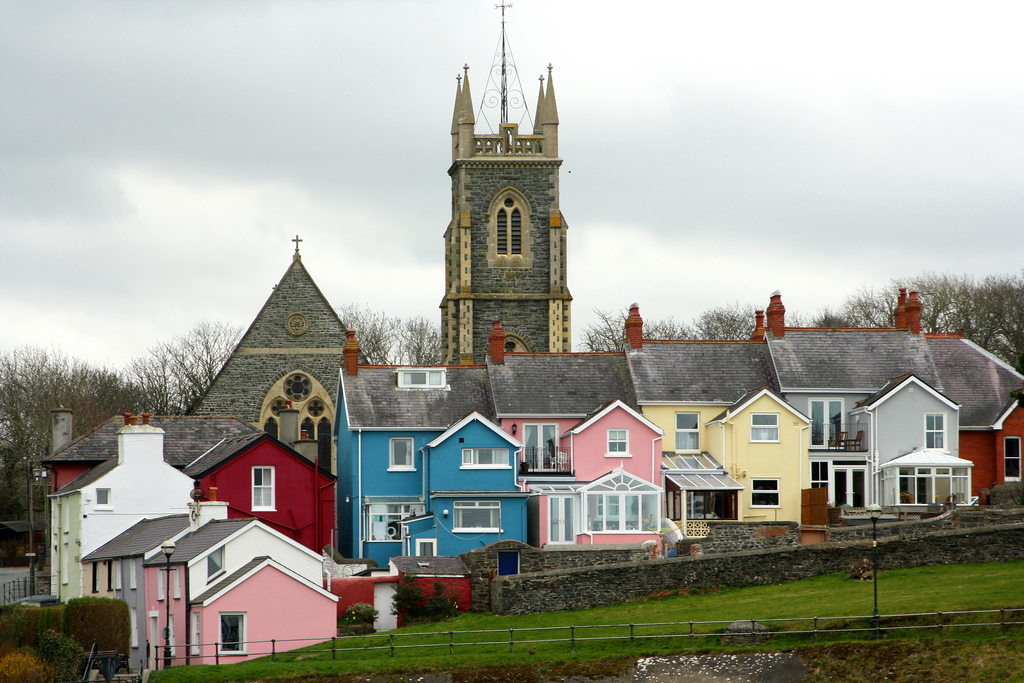
One of the defining characteristics of Aberaeron is its colour. The Georgian terraces that line the harbour and the surrounding streets are painted in bold, individual shades — deep reds, sky blues, warm pinks, primrose yellows, sage greens — giving the town a distinctly cheerful, almost Mediterranean quality that is quite unlike anywhere else in Wales.
Rising above the rooftops is the tower of Holy Trinity Church, a Victorian Gothic addition to the townscape that provides both a focal point and a useful landmark for those exploring the back streets on foot. The church serves the English-speaking congregation of the town; Welsh-language worship takes place at the various Nonconformist chapels that reflect the strong Calvinist Methodist tradition of Ceredigion.
Together, the painted terraces, the church tower, and the working harbour create a visual identity so distinctive that Aberaeron has become one of the most photographed small towns in Wales — and a firm favourite for artists, photographers, and those who simply appreciate beauty in an unexpected place.
Deeper History: Castell Cadwgan and the Medieval Shore
Although the architecture that defines Aberaeron dates from the 19th century, the area has a much older story. On the shoreline stood Castell Cadwgan, a 12th-century fortification associated with Cadwgan ap Bleddyn, a prince of Powys whose turbulent and colourful life is recorded in the medieval Welsh chronicle Brut y Tywysogion. Centuries of erosion by the sea have reduced the castle to little more than earthwork mounds and the faint traces of an enclosure bank, but the site is a reminder that Aberaeron's strategic position on Cardigan Bay was recognised long before Rev Gwynne drew his plans.
Llanerchaeron — National Trust
Just 2.5 miles east of Aberaeron along the Aeron valley lies Llanerchaeron, one of the most complete surviving examples of a minor Welsh gentry estate. The villa was designed and built in 1795 by John Nash — the architect later responsible for Buckingham Palace and the Brighton Pavilion — for Colonel William Lewis. Nash designed the house, its service courtyard, and the walled garden as a self-sufficient working unit, and remarkably most of it survives intact.
Managed by the National Trust, visitors today can explore the laundry, the brewing room, the dairy, and the salting room, which together give a vivid picture of life on a Georgian country estate. The walled kitchen garden is particularly special, with ancient varieties of fruit trees — some believed to be around 200 years old — espaliered against its warm brick walls. The estate also runs an organic farm and lake walks through the surrounding parkland. It is well worth an afternoon of anyone's time.
Wildlife: Dolphins, Seals and Seabirds
Cardigan Bay is one of the most important wildlife habitats on the western seaboard of Britain, and Aberaeron sits right in the middle of it. The bay is home to Europe's largest resident population of bottlenose dolphins — around 250 individuals — and sightings from the headlands and coastal paths around Aberaeron are not uncommon, especially in summer. New Quay, just 7.5 miles along the coast, is one of the best places in the UK to see dolphins at close quarters from the shore, and regular boat trips depart from both New Quay and Aberaeron to increase your chances further.
Atlantic grey seals are frequently seen hauled out on the rocks below the coastal cliffs south of Aberaeron, and the waters offshore attract significant numbers of seabirds including gannets, Manx shearwaters, storm petrels, and in winter, great northern divers and seaducks. Red kites — once almost extinct in Britain — are now a common sight soaring above the Aeron valley and the surrounding farmland.
Food, Drink and the Famous Honey Ice Cream
Aberaeron has built a quietly impressive reputation for food. The town has several good restaurants and cafes making use of fresh local produce — fish and shellfish from Cardigan Bay, meat from the surrounding farms, and vegetables and fruit from the fertile Ceredigion countryside. The Harbourmaster Hotel on Pen Cei is widely regarded as one of the finest places to eat on the west Wales coast, combining contemporary Welsh cooking with one of the most spectacular harbour-view settings imaginable.
Among Aberaeron's most beloved local institutions is the Hive on the Quay, a café and shop specialising in honey and bee products from local hives. Their honey ice cream has achieved something approaching legendary status among regular visitors — creamy, distinctively flavoured, and best eaten sitting on a harbour wall in the sunshine. It is the kind of simple pleasure that defines what Aberaeron does best.
Walking and Cycling
Aberaeron sits on the Wales Coast Path, the long-distance walking route that follows the entire Welsh coastline. Heading south from the town, the path takes you through dramatic cliff scenery to New Quay in around 4 miles, passing secluded coves and offering spectacular views across Cardigan Bay — on a clear day you can see the Llŷn Peninsula far to the north. Heading north, a 7-mile stretch of coastal walking leads to Llanrhystud, passing the hamlet of Aberarth and continuing through farmland and clifftop paths with sea views throughout.
For cyclists, the quiet lanes of Ceredigion provide excellent riding. A popular circular route of around 13 miles takes in Aberaeron, New Quay and the Aeron valley, returning via the B-roads through Ciliau Aeron. National Cycle Network Route 82 passes nearby, and the network of farm tracks and country lanes rewards those willing to explore at a gentle pace.
Find a Place to Stay
Search and book accommodation in and around Aberaeron:
Search Booking.comWeather in Aberaeron
Weather data provided by the Met Office

Aberaeron Harbour © Crown copyright (2013) Visit Wales
Explore Aberaeron

Dolphin Boat Trips
Cardigan Bay is home to hundreds of bottlenose dolphins. Book a one or two hour spotting trip from New Quay or Aberaeron.

Walking & Cycling
Follow the coastal path to New Quay (4 miles) or north to Llanrhystud (7 miles), or enjoy cycle routes of 9–13 miles.

New Quay
Just 7.5 miles along the coast, New Quay offers safe sandy beaches, a picturesque harbour, and great dolphin watching.
 Explore Wales
Click on a town below to visit other areas of Wales — or view the full map at Croeso.com